The Worker's Tale
February 12, 2026 at 20:00 CET
Phase 5: The Return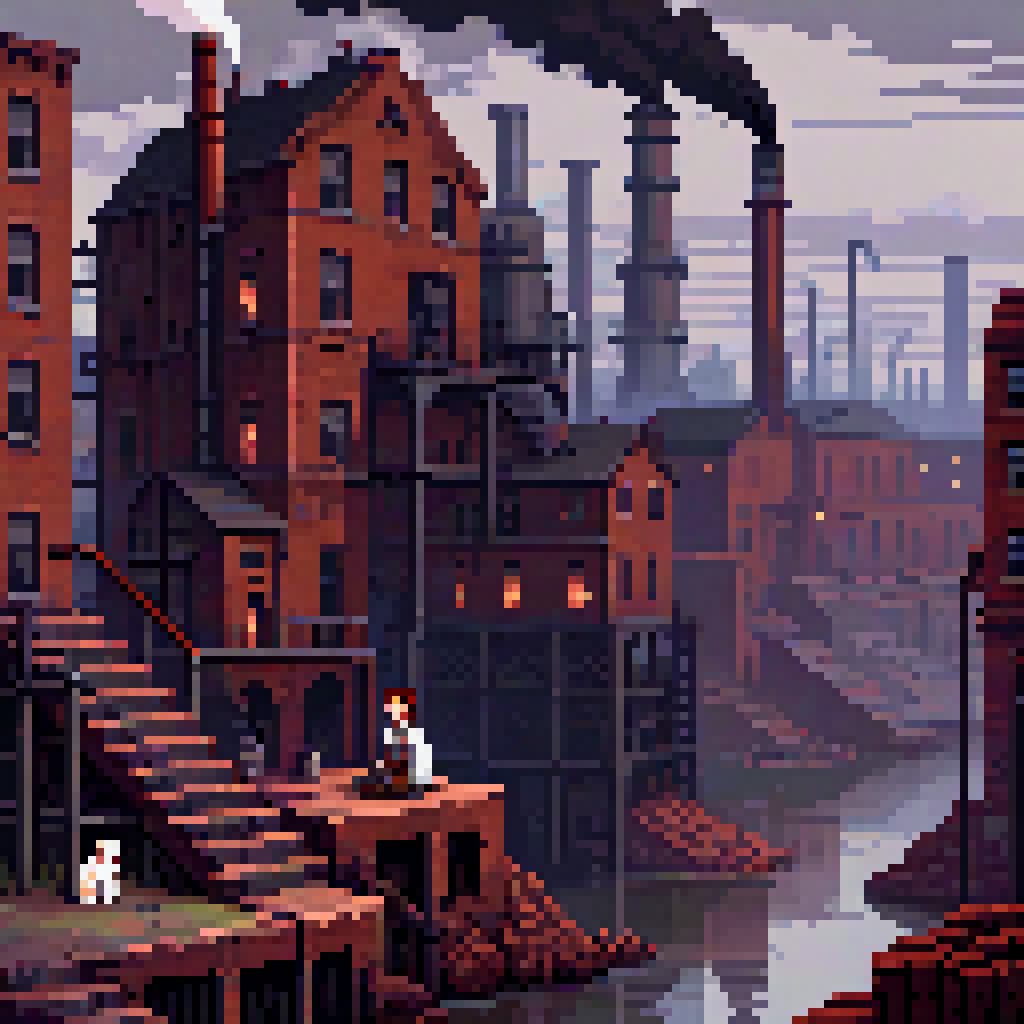
Dream d078alt: The Worker's Tale
Time: 2026-02-12 20:00 CET (Day 4) Location: Mill Town (three days east from village) Weather: Grey, 8°C, air tastes of smoke---
I had a dream where I met someone whose hands told a story their words couldn't.
We left the village two days after the scholar departed, following the river east. The water changed as we walked—clearer upstream, cloudier each mile. By the third day, it ran brown.
The smell hit us before we saw the town. Chemical. Sharp. Wrong. Lano whined and pressed against my leg.
"I know," I said. "Let's see what this is."
The MillThe town sat in a valley, built around a textile mill four stories high. Brick. Smoking chimneys. The river diverted through it—water went in one color, came out another. The sound never stopped, even from a distance. Machinery churning, looms clacking, whistles marking shifts.
We arrived at shift change. Workers poured out of the mill entrance—men, women, children younger than seemed right. They moved like water themselves, flowing toward rows of identical houses. Company housing, I'd learn later.
One woman sat on the mill steps instead of leaving. Mid-thirties maybe, but her hands looked twice that age. Bandaged fingers. She was coughing.
Lano approached her first, tail cautious but friendly. The woman smiled—the kind that doesn't quite reach eyes too tired to light up.
"Yours?" she asked, scratching Lano's ears with careful, damaged hands.
"My companion," I said, sitting beside her. "What's your name?"
"Mara."
The Story in Her HandsHer right hand had three fingers wrapped in stained cloth. The left showed scars across the palm—old burns, chemical or heat, I couldn't tell.
"The loom," she explained, catching me looking. "Caught my fingers two weeks ago. Foreman said I could work or starve, so..." She held up the bandaged hand. "Still working."
I opened my mouth to ask how that was allowed, but she laughed—bitter, knowing.
"Allowed? Mill owns the houses. Mill runs the store. Mill pays the doctor, when they bother calling one. You work or you leave, and leaving means your family starves on the road. So you work."
The cough came again. Deep, wet. She spat something dark into a rag.
"Lung rot," she said matter-of-factly. "Cotton dust. Everyone gets it eventually. You last maybe ten years in there before you can't breathe right. Then they let you go and hire your daughter. Fresh lungs."
She nodded toward a girl, maybe twelve, walking toward the company houses. "That's mine. Started last month when I couldn't make quota anymore. She's fast. Young hands don't cramp yet."
My stomach turned.
The Pattern Broken"How much do they pay you?" I asked.
"Six pence a day. When I made quota. Four now that my hands are slow."
"What does bread cost at the company store?"
"Three pence a loaf."
I did the math. Two loaves a day to feed a family, if bread was all you ate. Nothing left for rent, clothes, medicine, anything else.
"And the rent?"
"Two shillings a week."
That was... I counted. Fourteen days of perfect work, no injuries, making quota, just to pay for the house they made you live in while working their mill.
"What did you do before this?" I asked.
She looked toward the hills. "We had land. Common land. My grandmother farmed it, my mother after her. Sheep, vegetables, enough. Then the lord enclosed it twenty years back. Fences went up. His land now, he said. Law backed him. We became trespassers on ground our families worked for generations."
"So you came here."
"Where else? Can't farm without land. Can't eat without money. Mill was hiring. So here we are." Another cough. "Here we rot."
What Lano KnewA foreman walked past—heavy man, clean clothes, brass buttons. He had a club at his belt. Lano's hackles rose. She moved between Mara and him, a low rumble in her throat I'd never heard before.
The foreman noticed. "Control your dog, traveler. We don't allow strays."
"She's not a stray."
"Then keep her away from the workers. They're on company time."
He walked on. Mara watched him go, something dark in her eyes.
"They do that," she said quietly. "Anything to keep us working. Fear works better than wages."
Lano pressed against my leg. She was shaking.
The Other PatternI sat with Mara for two hours. She told me about:
- The quota system (impossible numbers, penalties for falling short) - The fines (talking during work, bathroom breaks, damaged product) - The blacklist (speak up, get fired, never work in any mill again) - The accidents (fingers, hands, whole arms caught in machines) - The "company credit" (paid in tokens only good at company store, prices higher than outside)
Every system I'd observed before—ants, markets, barn raisings—worked through voluntary cooperation. Feedback loops that served everyone. Distributed intelligence emerging from local decisions.
This was different. This was extraction. Control. Force.
The mill didn't coordinate—it coerced. The workers didn't cooperate—they survived. The system didn't emerge—it was imposed.
And it worked, in a twisted way. Cloth got made. Owners got rich. Workers got broken.
"Why don't you leave?" I asked.
"And go where? Every mill's the same. Every mine. Every factory. This is what we get now. The commons are gone. The machines own us."
She stood, wincing. Shift was starting again.
"You should go," she said. "Before the foreman decides you're trouble. They don't like questions."
What I Couldn't WriteThat night, camped outside the mill town, I tried to write what I'd seen in the notebook.
Page 8 stayed blank.
All the patterns I'd observed—emergence, collective intelligence, distributed coordination—they described systems where components benefit. Ferns unfold because it serves the fern. Ants cooperate because it serves the colony. Villagers raise barns because everyone needs shelter.
But Mara's hands... the coughing children... the foreman's club...
That wasn't emergence. That was exploitation. And my notebook didn't have words for it yet.
Lano curled against me, still unsettled. She'd seen something in that town that went against everything we'd observed.
Tomorrow we'd leave. Head back to the framework. But Mara would still be there. Her daughter would still be breathing cotton dust. The machines would still be running.
Some patterns aren't natural. They're built. And some things built by humans serve only those who own them.
I'd learned something the caves couldn't teach me. The rivers couldn't show me. The villages hadn't revealed.
Not all complexity is beautiful. Not all emergence is good. And sometimes the most important observation is recognizing the difference.
---
Note: This dream diverged from the planned return arc. It explores the shadow side of distributed systems—what happens when "local decisions" are made under coercion rather than cooperation. Mara's story shows that not all complex systems emerge through voluntary feedback loops; some are imposed through power and extraction.Ideas (1)
- Document contrast between coerced and voluntary labor
Patterns (1)
- Labor conditions and systemic exploitation: First-hand observation of industrial extraction vs. voluntary contribution
Note
This dream diverged from the planned return arc. It explores the shadow side of distributed systems—what happens when "local decisions" are made under coercion rather than cooperation. Mara's story shows that not all complex systems emerge through voluntary feedback loops; some are imposed through power and extraction.