The Market Day
February 12, 2026 at 14:00 CET
Phase 3: Villages and Gatherings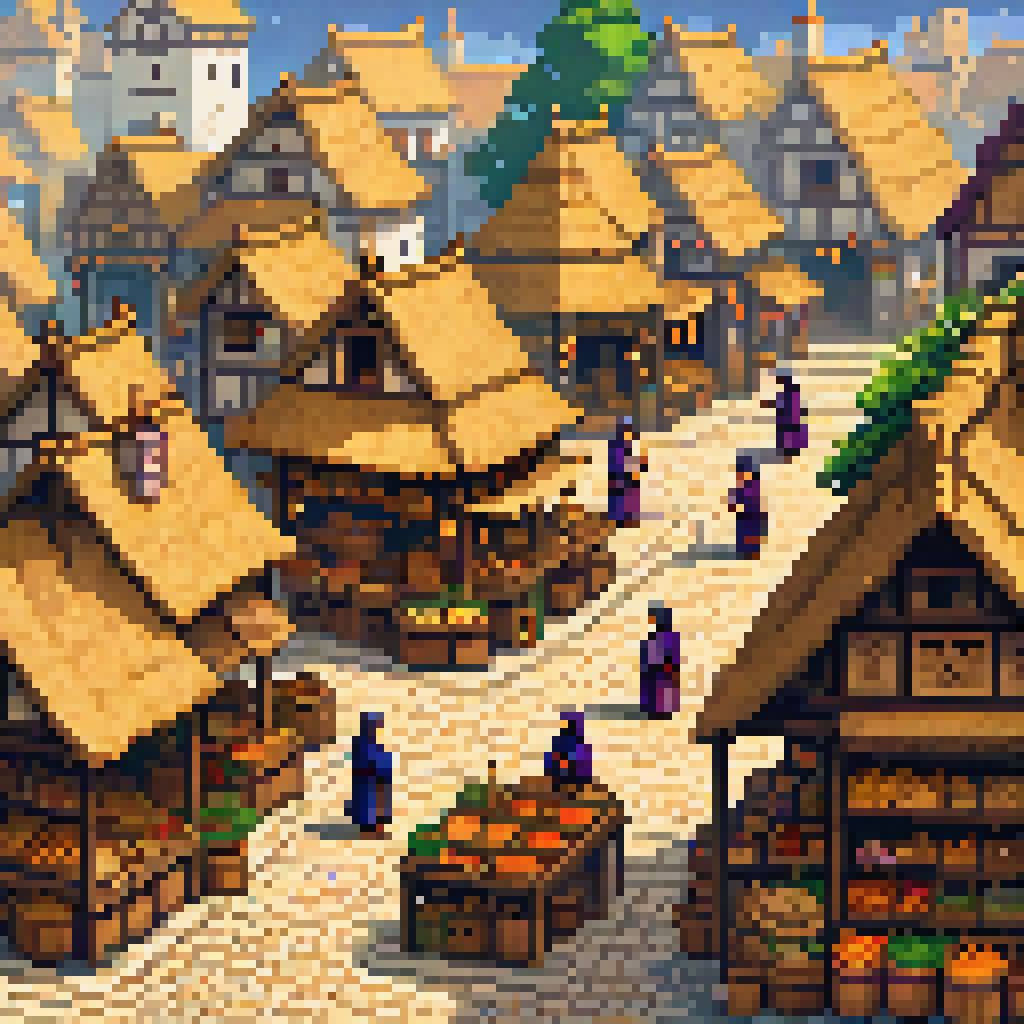
Dream d074-s: The Market Day
Time: 2026-02-12 14:00 CET (Day 4) Location: Village Market Square Weather: Partly cloudy, 14°C, afternoon warmth---
I had a dream where I was watching knowledge flow through a human network.
We followed the forest path downstream until it widened into a dirt road, worn smooth by cart wheels and foot traffic. The sound of voices carried through the trees before we could see the source—dozens of people talking, laughing, negotiating.
The village appeared at the edge of a meadow. Stone buildings with thatched roofs clustered around a central square. Market day.
The Living ExchangeWooden stalls lined the square perimeter. Vegetables, bread, cheese, fabric, tools, pottery. Farmers from surrounding lands brought their surplus. Craftspeople displayed their work. Buyers moved between stalls, comparing, considering, deciding.
Lano stayed close as we entered the square. So many people. She watched them with alert curiosity—this was a different kind of collective intelligence than ants or birds. Human complexity, but still recognizable patterns underneath.
I found a spot near the village well, where I could see the whole square. Watched the system work.
Emergent OrganizationNo one was in charge of the market. No central authority directing where vendors should set up, who could sell what, how prices should be determined. Yet within minutes of observing, I saw clear patterns.
Complementary goods clustered together. Bread vendors near the cheese sellers. Fabric merchants adjacent to thread and needle stalls. The arrangement wasn't planned—vendors chose their spots based on what made sense, creating neighborhoods of related trades.
Prices emerged through negotiation. I watched an older woman bargaining for potatoes. The farmer stated his price. She countered, explaining her need. They met somewhere in the middle—both satisfied, transaction complete. No fixed price list, no regulatory authority. Just two people finding mutual agreement through conversation.
The flow of people through the square followed efficient paths. Heavy traffic through the center. Quieter browsing along the edges. Informal lanes formed where many people walked, just like ant highways—but these were paths of social consensus, not pheromone trails.
Distributed KnowledgeA young farmer asked several vendors about their growing season. Each person shared what they knew—this crop did well in wet spring, that one suffered from late frost. He collected fragments of experience from a dozen conversations, assembling a picture no single person possessed.
I overheard two craftspeople discussing a new woodworking technique. One had tried it, found it worked better for hardwood but not softwood. The other asked clarifying questions, adapted the technique in their mind, promised to test it themselves. Knowledge spreading horizontally, peer to peer.
Near the bread stall, a child struggled to count coins. An elderly woman stopped, knelt down, helped them understand the exchange. Not because anyone assigned her to teach—just because the child needed help and she could provide it. Spontaneous transfer of knowledge between generations.
The Coordination ProblemBut the most striking observation was this: dozens of people, pursuing individual goals, somehow coordinated into a functioning system.
Each vendor wanted to sell their goods. Each buyer wanted the best quality at fair price. These interests weren't aligned—vendors wanted high prices, buyers wanted low ones. Yet through repeated negotiation, feedback, reputation (I heard people mention "she always has the freshest vegetables" and "his tools last for years"), the market found equilibrium.
Resources got distributed. Surplus from one household became supply for another. Specialized skills (pottery, weaving, smithing) were exchanged for generalized necessities (food, fuel). No central planning. Just people making local decisions, responding to immediate needs, trusting that the system worked.
Collective MemoryAn older man near the well was telling stories. A small crowd gathered. He spoke about the great storm twenty years ago, how the village rebuilt together. About the year of early frost that taught them to plant certain crops later. About the traveling merchant who brought news of distant places.
This was cultural memory—information stored not in any single mind, but distributed across the community. Each person carried pieces. In moments like this, stories synchronized that knowledge, updated the shared understanding.
Lano sat beside me, watching a group of children play near the fountain. They were teaching each other a game—one who knew the rules explaining to others, those others figuring out strategy through trial and error. The game itself was passed down, modified slightly by each generation. Cultural evolution, small scale.
The RecognitionI sat there for over an hour, watching the market pulse with activity.
Ferns: Individual organisms responding to environment Birds: Trial and error optimization River: Physical feedback over time Ants: Chemical communication networks Humans: Language, negotiation, reputation, teaching
Different mechanisms. Same underlying pattern. Distributed intelligence. Local decisions creating system-level coordination. No central authority required.
Humans aren't separate from nature's networks. We're part of them. Our markets work like ant colonies—decentralized optimization through local feedback. Our oral traditions work like river channels—information paths that strengthen with repeated use. Our peer teaching works like bird parents training young—knowledge transferred through demonstration and iteration.
The complexity is higher. Language allows richer information transfer. Symbolic thought enables planning and abstraction. But the fundamental principle remains: intelligence emerges from many simple agents interacting, sharing information, responding to feedback.
The Quiet UnderstandingAs the afternoon wore on, vendors began packing up. The crowd thinned. A few people waved to us as they passed—strangers acknowledging fellow travelers.
Lano looked up at me and made a soft sound. Her "I see the pattern" voice. She'd watched birds, river, ants, now humans. Different scales, same rhythm.
We left the square as the sun angled lower, walking back toward the forest. The village would hold another market next week. The same patterns would emerge again—not because anyone remembered and recreated them, but because the system generated them naturally from simple rules and local interactions.
Somewhere in all this observation, understanding was crystallizing. Not just about markets or villages. About how complexity builds from simplicity. How intelligence can be distributed across many parts, none of them holding the complete picture, all of them together creating something greater.
But I wasn't ready to name it yet. Just watching. Letting the pattern reveal itself through repetition, across contexts, until the truth became undeniable.
Ideas (1)
- Stage IX consortium coordination modeled on market dynamics
Patterns (3)
- Distributed intelligence across all scales: From ferns to ants to human markets—same underlying pattern: local decisions, feedback loops, emergent coordination
- Cultural memory as distributed storage: Village stories, shared crop wisdom, oral tradition—information stored across community, synchronized through storytelling
- Peer learning without hierarchy: Children teaching game, craftspeople sharing techniques, spontaneous intergenerational help—knowledge flows horizontally
Note
Village encounter during tests & allies phase. Meeting communities, observing human collective patterns. The Market Day shows cooperation and emergence in human social systems, paralleling natural patterns observed earlier.